
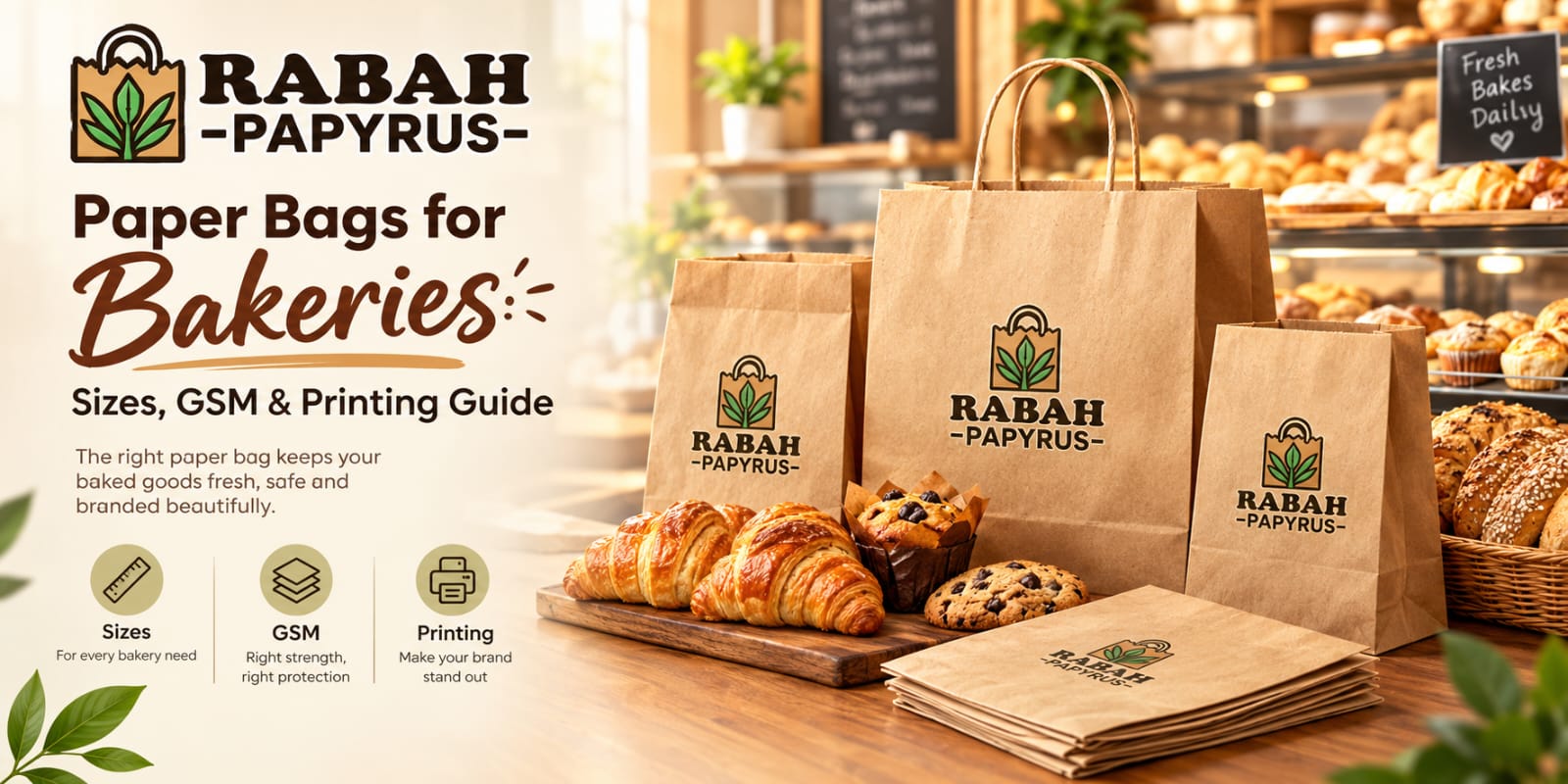
A customer may remember the taste of a cake, but the packaging also contributes to the overall shopping experience. From carrying freshly baked bread to packing cookies, pastries, and bakery boxes, the right packaging improves convenience and presentation. This is why bakery paper bags have become a practical packaging choice for bakeries of different sizes.
Choosing the right bakery paper bags involves more than selecting an attractive design. Bakery owners need to consider bag dimensions, paper quality, GSM, handle options, and printing requirements. The right combination helps businesses pack their products comfortably, maintain a professional appearance, and provide customers with convenient packaging.
In this guide, we will explain the different types of bakery paper bags, how to select the right size, what GSM means, and how printing can help promote your bakery brand.
1. Why Are Paper Bags a Good Choice for Bakeries?
Packaging is essential to running a bakery because customers need a convenient way to carry their purchases. Whether someone buys a few cookies, a loaf of bread, or multiple bakery boxes, the packaging should suit the product and make transportation easier.
Paper bags offer a simple and professional appearance that works well for different bakery businesses. They can be customised with a bakery’s name, logo, and brand colours, helping businesses create a consistent identity.
Another advantage is the availability of different sizes and paper thicknesses. Small bakeries can select bags for individual purchases, while larger bakeries can choose suitable options for multiple products and takeaway orders.
Paper bags can also serve as an alternative to certain plastic carry bags. When selected and disposed of responsibly, they can support businesses looking to improve their packaging practices.
2. Types of Bakery Paper Bags
Not every bakery has the same packaging requirements. A bakery selling individual products may need different bags from one that regularly packs multiple items or product boxes.
Choosing the right bakery packaging depends on the type of products being sold, their size, weight, and how customers will carry them. Some commonly used options include paper bags with handles, without handles, V-bottom paper bags, and paper pouches.
2.1 Paper Bags Without Handles
Paper bags without handles are commonly suitable for smaller purchases and lightweight bakery products. They can be used for items such as cookies, biscuits, rusks, and other appropriately packaged bakery products.
These bags are useful for everyday transactions where customers do not need additional support to carry their purchases. Their simple design also makes them suitable for bakeries that prefer straightforward packaging.
When selecting a bag without handles, consider the product dimensions and the number of items being packed. The bag should provide enough room for the products without becoming overcrowded or difficult to carry.
2.2 Paper Bags With Handles
Paper bags with handles are a convenient option for customers purchasing multiple bakery items or larger product boxes. They make carrying purchases easier, particularly when customers are travelling from the bakery to another location.
For example, a customer purchasing a cake box along with other bakery products may find a suitable handled paper bag more convenient than carrying individual packages.
However, the bag size, paper GSM, base construction, and handle attachment should be considered together. Selecting the right combination helps ensure that the bag is suitable for its intended use.
2.3 V-Bottom Paper Bags
V-bottom paper bags are commonly used for packaging individual bakery products and smaller food items. Their distinctive folded bottom creates a V-shaped structure, making them suitable for products such as bread rolls, buns, cookies, and other lightweight bakery items.
These bags are particularly useful for bakeries that need simple, practical packaging for quick customer purchases. They can also help keep individual products organised during handling and transportation.
When choosing V-bottom paper bags, bakeries should consider the product size, paper quality, and overall bag dimensions to ensure a suitable fit.
2.4 Paper Pouches
Paper pouches are another practical packaging option for bakeries. They are particularly suitable for smaller products such as cookies, puffs, pastries, and other bakery snacks.
Their compact design makes them convenient for individual portions and takeaway purchases. Depending on the material and construction, paper pouches can also be designed with features such as windows, allowing customers to see the product inside.
Paper pouches are useful for bakeries looking for simple, lightweight packaging that keeps products neatly packed while providing an attractive presentation.
Both handled and handle-free paper bags, V-bottom bags, and paper pouches can serve different bakery packaging needs. The final choice should depend on the products being packed, their weight, storage requirements, and the convenience expected by customers.
3. Bakery Paper Bag Sizes: How to Choose the Right One
Selecting the correct paper bag size is important for both product presentation and everyday convenience. A bag that is too small can make packing difficult, while an unnecessarily large bag may use more material and make the packaging look untidy.
Bakery owners should first understand the dimensions of the products they regularly sell. For example, cookies and rusks generally require less space than multiple bread packets or bakery product boxes. Similarly, a bag intended for a single purchase may not be suitable for customers carrying several items together.
3.1 Choosing Bag Sizes Based on Bakery Products
Different bakery products require different amounts of packaging space. Small products such as cookies and rusks can generally be packed in appropriately sized bags without handles. Bread, buns, and multiple bakery purchases may require larger dimensions depending on the quantity and weight.
For bakery product boxes, the bag should be wide and tall enough to accommodate the box comfortably. It is also important to consider the base space so that the box sits properly inside the bag.
For larger takeaway orders, bakery owners should consider the combined dimensions and weight of all the products. Choosing a suitable bag helps customers carry their purchases more conveniently and reduces the possibility of packaging problems.
3.2 How to Measure the Correct Paper Bag Size
Before ordering paper bags, measure the products or boxes that will be packed. Start by checking their length, width, and height. These measurements help determine the minimum space required inside the bag.
It is also important to allow some additional room so that products can be placed inside and removed easily. Avoid selecting a bag that fits the product too tightly, as this can affect convenience and presentation.
The bottom space deserves particular attention when choosing bags for bakery boxes or multiple products. The base should accommodate the packed items properly and be suitable for their expected weight.
For businesses using handled bags, the handle design and overall carrying comfort should also be considered. Testing a sample with actual bakery products is one of the most reliable ways to confirm whether the selected dimensions are suitable.
4. Understanding GSM in Bakery Paper Bags
GSM stands for grams per square metre. It refers to the weight of paper per square metre and is commonly used to describe paper weight.
When purchasing bakery paper bags, GSM is an important factor because it helps businesses understand the paper specifications. Different products and bag dimensions may require different paper weights depending on their intended use.
For example, a bag used for lightweight bakery purchases may have different requirements from one used to carry multiple product boxes. However, choosing a higher GSM does not automatically guarantee a stronger finished bag. The dimensions, construction, bottom design, and handle attachment also influence its overall performance.
Rabah Papyrus offers paper bags in four GSM options: 80 GSM, 90 GSM, 100 GSM, and 120 GSM. These options allow businesses to consider different paper weights according to their packaging requirements.
4.1 How to Select the Right GSM
The right GSM should be selected by considering the weight and dimensions of the products being carried. For lightweight purchases, businesses may explore lower GSM options, while packaging that requires additional paper weight may call for higher GSM options.
However, bakery owners should not make their decision based on GSM alone. A larger bag carrying multiple products may require a different specification from a smaller bag carrying a single item, even if the paper weight is the same.
The best approach is to discuss your product requirements with the manufacturer and test a sample before placing a bulk order. This helps you understand whether the selected paper weight and bag construction are suitable for your daily business needs.
5. Printing Guide for Bakery Paper Bags
Printing is one of the most useful ways to turn ordinary packaging into a branding opportunity. A paper bag displaying your bakery’s name and logo can help customers recognise your business even after they leave the store.
For bakeries, packaging is often part of the customer’s first impression. A neatly printed bag creates a consistent appearance and helps connect the packaging with the products and overall identity of the business.
Before selecting a printing design, bakery owners should consider the available printing area, brand colours, logo size, and overall appearance of the bag.
5.1 What Should You Include in Your Bakery Bag Design?
A good bakery bag design should be simple, readable, and connected to your brand identity. Your bakery’s logo and business name are usually the most important elements because they help customers identify your business.
You can also include contact information, a website, or social media details if there is enough space. However, adding too much information can make the design look crowded.
For example, a bakery with a simple logo and two brand colours can use those elements consistently across its packaging. This creates a recognisable appearance without requiring complicated designs.
5.2 How to Make Printed Paper Bags Look Professional
The quality and placement of printing can influence the overall appearance of the bag. A logo should be clear and positioned where customers can easily notice it. Colours should complement the paper, while text should remain readable at the final printing size.
It is also useful to review the design before production begins. Share your artwork with the manufacturer and ask for a sample or printing proof when available. This helps you check the placement, appearance, and readability before confirming a larger order.
A well-planned design can make your bakery packaging look professional while giving customers a consistent brand experience.
6. How to Choose a Reliable Bakery Paper Bag Manufacturer
Choosing a suitable manufacturer is an important part of managing your bakery’s packaging requirements. The right supplier should understand the type of products you sell and help you identify suitable bag dimensions, GSM, and printing options.
Start by checking the available paper bag specifications. Not every manufacturer offers the same paper weights, dimensions, or handle options. Understanding these details helps you identify whether the supplier can meet your requirements.
Paper quality is another important consideration. Ask about the available GSM options and discuss the expected weight of your bakery products. A manufacturer should be able to explain the available specifications so that you can make an informed decision.
Printing capabilities should also be considered if you want branded packaging. Share your logo and design requirements in advance, and confirm the available printing options, minimum order quantity, and any additional charges.
Before placing a large order, request samples and check the finished bag with your actual products. Examine its dimensions, paper quality, bottom construction, handle attachment, and printing appearance.
Finally, discuss production timelines, delivery schedules, and the supplier’s ability to maintain consistent quality across repeat orders. These factors become particularly important when your bakery depends on a regular supply of packaging.
7. Common Mistakes to Avoid When Buying Bakery Paper Bags
Selecting paper bags without understanding your actual packaging needs can lead to unnecessary expenses and inconvenience. One common mistake is choosing bags based only on price. A lower-priced option may not always provide the specifications required for your products, so paper quality and suitability should also be considered.
Another mistake is selecting the wrong bag dimensions. Bags that are too small can make packing difficult, while oversized bags may use more material than necessary. Measuring your products before ordering helps avoid these problems.
Ignoring GSM and expected product weight can also affect the suitability of the packaging. Bakery owners should consider paper weight along with bag construction, dimensions, and handle design rather than relying on a single specification.
Some businesses also overlook the importance of testing samples. A bag may look suitable when empty but perform differently when filled with actual products. Testing a sample helps identify possible issues before confirming a bulk order.
Finally, avoid making the printing design unnecessarily complicated. Too many colours, text elements, or graphics can reduce readability. A simple design that clearly displays your bakery’s identity is often more effective.
8. Frequently Asked Questions About Bakery Paper Bags
What is the best GSM for bakery paper bags?
The best GSM depends on the dimensions of the bag, the weight of the products, and the bag’s construction. Paper bags are available in different GSM options, and the suitable choice should be based on the intended use. Rabah Papyrus offers 80 GSM, 90 GSM, 100 GSM, and 120 GSM options.
Should I choose bakery paper bags with or without handles?
Paper bags without handles may be suitable for smaller purchases and lightweight products. Bags with handles can provide additional convenience when customers carry multiple products or larger bakery boxes. Consider the product size, weight, and expected carrying requirements before making a decision.
Can I print my bakery logo on paper bags?
Yes. Custom-printed paper bags can display your bakery’s logo, business name, and brand colours. A clear and simple design can improve brand recognition and create a consistent appearance. Discuss your artwork, printing requirements, and order quantity with the manufacturer before confirming production.
How do I choose the correct paper bag size for my bakery?
Start by measuring the length, width, and height of the products or boxes you want to pack. Allow enough space for comfortable placement and consider the total weight of the contents. Testing a sample with your actual bakery products can help you confirm whether the dimensions are suitable.
Are paper bags suitable for all bakery products?
Paper bags can be suitable for carrying many bakery purchases, including appropriately packaged cookies, rusks, bread, and bakery boxes. However, products that require protection from grease or moisture should have suitable primary packaging before being placed inside a paper carry bag. The bag should be selected according to the product and its packaging requirements.
Conclusion
Choosing the right bakery paper bags is an important decision that affects more than the appearance of your packaging. The right bag should provide enough space for your products, be suitable for their weight, and make it convenient for customers to carry their purchases.
Before placing an order, take time to understand your bakery’s regular packaging requirements. Consider the dimensions of your products, the appropriate GSM, and whether handled or handle-free bags are more suitable. If you plan to use printed bags, make sure the design reflects your bakery’s identity while keeping the logo and important details easy to recognise.
It is equally important to work with a manufacturer who can explain the available specifications and maintain consistent product quality. Requesting samples and testing them with your actual products can help you avoid unsuitable packaging choices and make better purchasing decisions.
At Rabah Papyrus, based in Pendurthi, Visakhapatnam, we offer paper bags with and without handles in 80 GSM, 90 GSM, 100 GSM, and 120 GSM options. Businesses can explore suitable paper bag specifications and printing options according to their packaging and branding requirements.
Ultimately, good bakery packaging should bring together convenience, suitable paper quality, and brand presentation. When these factors are considered carefully, paper bags become more than just packaging; they become a useful part of the customer’s experience with your bakery.
Looking for paper bags for your bakery? Get in touch with Rabah Papyrus.
Rabah Papyrus
- Contact: 79890 98789
- Website: www.rabahpapyrus.com
- Location: Pendurthi, Visakhapatnam, Andhra Pradesh, India